
The Case for Going Thin
If you have ever sat down at a restaurant and quietly shifted your weight to one side because the brick in your back pocket was digging into your leg, you already understand why the minimalist ultra thin wallet has become one of the most searched everyday carry upgrades of the past few years.
The old-school bifold served us well for decades. It held everything: loyalty cards from coffee shops you visited once in 2019, expired insurance cards, receipts you swore you would file, and enough cards to stock a small bank branch. The problem is that most of us never actually needed all of that on a Tuesday afternoon. We just carried it anyway, out of habit.
The shift toward slim, minimal card holders is not just a design trend. It reflects a genuine change in how people move through daily life. Tap-to-pay is everywhere. Digital wallets handle more transactions every year. The physical cards you actually reach for on any given day probably number three or four, not twelve.
So the question is no longer whether a slim wallet makes sense. The question is which one is worth your money, and what should you actually look for before you buy.
"The best wallet is the one you forget is there. Not because it disappeared, but because it stopped being a problem."
What Actually Matters in a Slim Wallet
Shopping for a minimalist wallet can feel deceptively simple. They all look similar in product photos. They all promise to be slim. But spend a few weeks with the wrong one and the differences become painfully obvious. Here is what separates a wallet you will love from one that ends up in a drawer.
Capacity That Matches Real Life
The sweet spot for a minimalist card holder is somewhere between four and eight cards. Fewer than that and you are constantly making impossible choices at the checkout counter. More than that and the wallet starts to bulk up, defeating the entire purpose.
Think about your actual daily carry. Most people use a debit card, one or two credit cards, and an ID. Everything else is situational. A well-designed slim wallet should handle your essentials without stretching, warping, or becoming difficult to open after a few months of use.
The Way Cards Come Out
This sounds minor until you are standing in a checkout line with people behind you. Some slim wallets require you to pinch and pull individual cards from a tight sleeve, which gets frustrating fast. The better designs use a thumb push or fan-out mechanism that lets you see and grab exactly the card you want in under two seconds.
Speed and ease of access matter more than almost any other factor in daily use. A wallet that looks great in photos but makes you fumble at the register is not a good wallet.
How It Sits in Your Pocket
A truly slim wallet should disappear into your front pocket. Not just fit, but disappear. You should be able to sit, stand, walk, and move without any awareness of it. If you are switching from a traditional bifold, the difference in how your clothes fit and how you feel when sitting will genuinely surprise you.
Front pocket carry is also safer than back pocket carry, which brings us to the next consideration.
Protection You Can Actually Trust
Modern contactless cards are convenient, but that convenience cuts both ways. The same technology that lets you tap and pay in seconds can, in theory, be read by someone with the right equipment standing close to you in a crowd. This is not science fiction, and it is not paranoia. It is a real enough concern that many travelers, commuters, and city dwellers actively look for wallets that address it.
The RFID Question, Answered
RFID blocking has become a standard feature request for slim wallets, and for good reason. But there is a lot of noise around this topic, so let us cut through it.
Your contactless credit cards, debit cards, and ID cards all use radio frequency signals to communicate with payment terminals. That is the technology that makes tap-to-pay possible. RFID blocking wallets are lined with a material that disrupts those signals, creating a shield around your cards when they are stored in the wallet.
The practical benefit is peace of mind in high-density environments: airports, subway stations, crowded markets, festivals. Whether or not you believe the threat is significant in your day-to-day life, having the protection costs you nothing extra when it is already built in.
"Think of RFID blocking the way you think about a seatbelt. You hope you never need it. You are glad it is there."
The Vaultek card holder builds this protection in without adding any bulk or changing how the wallet looks or feels. It is simply part of the design, not an afterthought or an upsell.
What RFID Blocking Does Not Do
It is worth being honest here. RFID blocking protects against electronic skimming of your contactless cards. It does not protect against lost cards, stolen wallets, or phishing. It is one layer of a sensible security approach, not a complete solution. But as one layer, it is a genuinely useful one.
Comparing Your Options
The slim wallet market has exploded. At any price point, you have dozens of choices. Here is an honest breakdown of how the main categories compare, so you can figure out where the Vaultek card holder fits in the landscape.
| Wallet Type | Best For | Trade-offs | Price Range |
|---|---|---|---|
| Traditional bifold | Cash carriers, loyalty card collectors | Bulky, back-pocket discomfort, no RFID protection | $15 to $200+ |
| Leather slim card case | Classic aesthetic lovers | Stretches over time, limited protection, higher cost | $30 to $150 |
| Metal rigid wallet | Maximum durability seekers | Hard edges, heavier, can scratch cards | $25 to $80 |
| Elastic band minimalist | Ultra-light travelers | No structure, cards can fall out, no RFID protection | $10 to $40 |
| RFID card holder (like Vaultek) | Daily commuters, tech-forward users, security-conscious buyers | Not ideal for large cash amounts | Budget-friendly |
The Budget Argument
One thing worth addressing directly: some people assume that a lower price means lower quality. In the slim wallet category, that assumption does not hold. The design and function of a card holder is not inherently complex. You are not paying for a mechanical movement or hand-stitched leather. You are paying for smart design, reliable materials, and features that work.
The Vaultek card holder delivers RFID protection, a clean modern look, and a thoughtful card-access design at a price that does not require you to justify the purchase to yourself for three weeks. That is genuinely a good thing.
The Aesthetic Argument
Design matters. Not in a superficial way, but in the sense that you interact with your wallet dozens of times every day. Something that looks and feels considered makes those interactions slightly better, every single time.
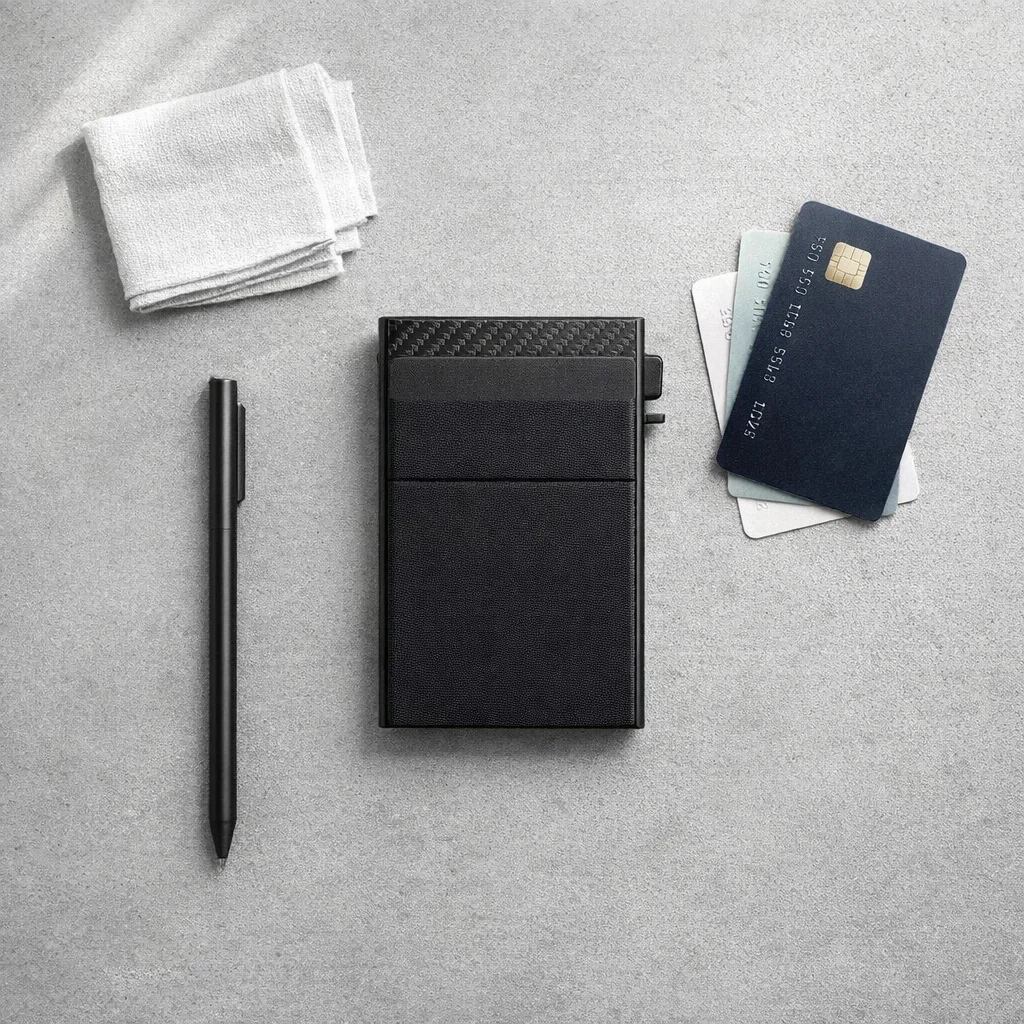
The carbon fiber texture on the front of this wallet reads as modern and intentional. It does not try to look like luxury leather or pretend to be something it is not. It has its own visual language: technical, clean, contemporary. For the person who carries a well-designed phone case and appreciates products that look like they were thought through, this aesthetic lands well.
Who This Wallet Is Really For
The best product recommendations are honest about fit. Not every wallet is right for every person, and the minimalist ultra thin wallet category has a specific ideal user. Let us be direct about who will love this and who might want something different.
You Will Love This If...
You carry your essentials and nothing more. You have already made peace with the fact that you do not need your gym membership card from 2021 in your pocket every day. You use tap-to-pay regularly and appreciate the idea of protecting those cards without thinking about it. You sit at a desk, travel frequently, or commute in crowds, and you want your pocket to feel lighter and your day to feel slightly more organized.
You are also someone who appreciates products that look intentional. Not flashy, not status-signaling, just well-designed. The kind of thing you pull out at a coffee shop and someone notices and asks about it.
You Might Want Something Else If...
You regularly carry significant amounts of cash. Slim card holders are not designed to be cash wallets, and forcing bills into one defeats the purpose. If cash is a regular part of your daily carry, a hybrid slim wallet with a dedicated cash slot might serve you better.
You also might want something different if you genuinely need to carry eight or more cards every single day. That is uncommon, but it exists. Know your actual carry needs before you buy.
The Unisex Reality
One genuinely underrated aspect of this wallet is how well it works across different styles and contexts. The design is not coded masculine or feminine. It is just clean and modern. It works in a suit jacket pocket, a jeans pocket, a bag, or a coat pocket. It does not make assumptions about who is carrying it, which is exactly right.
Partners who share similar carry habits often end up buying two. It is that kind of product.
Our Verdict and Recommendation
After looking at this honestly, here is where we land.
The Vaultek minimalist ultra thin wallet is a smart, practical everyday carry upgrade for anyone who has outgrown the stuffed bifold and wants something that works as well as it looks. The RFID protection is genuinely useful and built in seamlessly. The card access is quick and intuitive. The profile is slim enough to make a real difference in how your pocket feels.
At its price point, it is one of the most accessible ways to meaningfully improve a part of your daily routine that you interact with more than you probably realize. It is not trying to be a luxury item. It is trying to be a well-designed, reliable tool that makes your day slightly smoother. On that measure, it succeeds.
If you have been carrying the same overstuffed wallet for years and telling yourself you will sort it out eventually, this is a low-risk, high-reward way to finally do that.
"The upgrade you keep putting off is usually the one that makes the biggest difference once you actually make it."
Ready to make the switch? Shop the Vaultek minimalist ultra thin wallet here and see what your pocket feels like without the weight of a decade of accumulated cards.
Frequently Asked Questions
How many cards can a minimalist ultra thin wallet actually hold?
Most well-designed slim card holders comfortably hold between four and eight cards without bulking up. The Vaultek card holder is optimized for the cards you actually use every day: your ID, a debit card, one or two credit cards, and maybe a transit card. If you find yourself needing more than that regularly, it is worth asking whether all of those cards truly need to be in your pocket every day, or whether some could live in a bag or at home.
Does RFID blocking interfere with using my cards at the register?
Not at all. RFID blocking only works when your cards are inside the wallet. The moment you take a card out to tap or swipe, it functions completely normally. The shielding is passive and requires no activation. You simply remove your card, use it, and put it back. There is no setting to toggle and nothing to remember.
Can I still carry some cash with a slim card holder?
A small amount of folded cash can usually be tucked behind the cards in most slim wallets. It is not ideal for large bills or frequent cash use, but for the occasional bill or emergency cash, it works fine. If you regularly use cash, look for a slim wallet that includes a dedicated cash strap or pocket rather than forcing bills into a card-only design.
Is a minimalist wallet actually more secure than a traditional bifold?
In several ways, yes. Front pocket carry, which slim wallets encourage, is significantly harder to pickpocket than back pocket carry. The RFID blocking adds a layer of protection against electronic skimming. And carrying fewer cards means less damage if the wallet is lost or stolen. No wallet is theft-proof, but a slim front-pocket wallet with RFID protection is a meaningfully more secure setup than the average back-pocket bifold.
How do I know if I am ready to switch to a minimalist wallet?
A simple test: take everything out of your current wallet and sort it into two piles. Cards you used in the last two weeks, and everything else. If the "everything else" pile is larger, you are ready. Most people discover they have been carrying six to ten cards they never actually reach for. A slim wallet forces a healthy audit of what you actually need, and most people find the lighter carry genuinely improves their daily experience.